

UIS AI Chat
Finding information on the University of Illinois Springfield website is now easier than ever.
Learn More
Finding information on the University of Illinois Springfield website is now easier than ever.
Learn More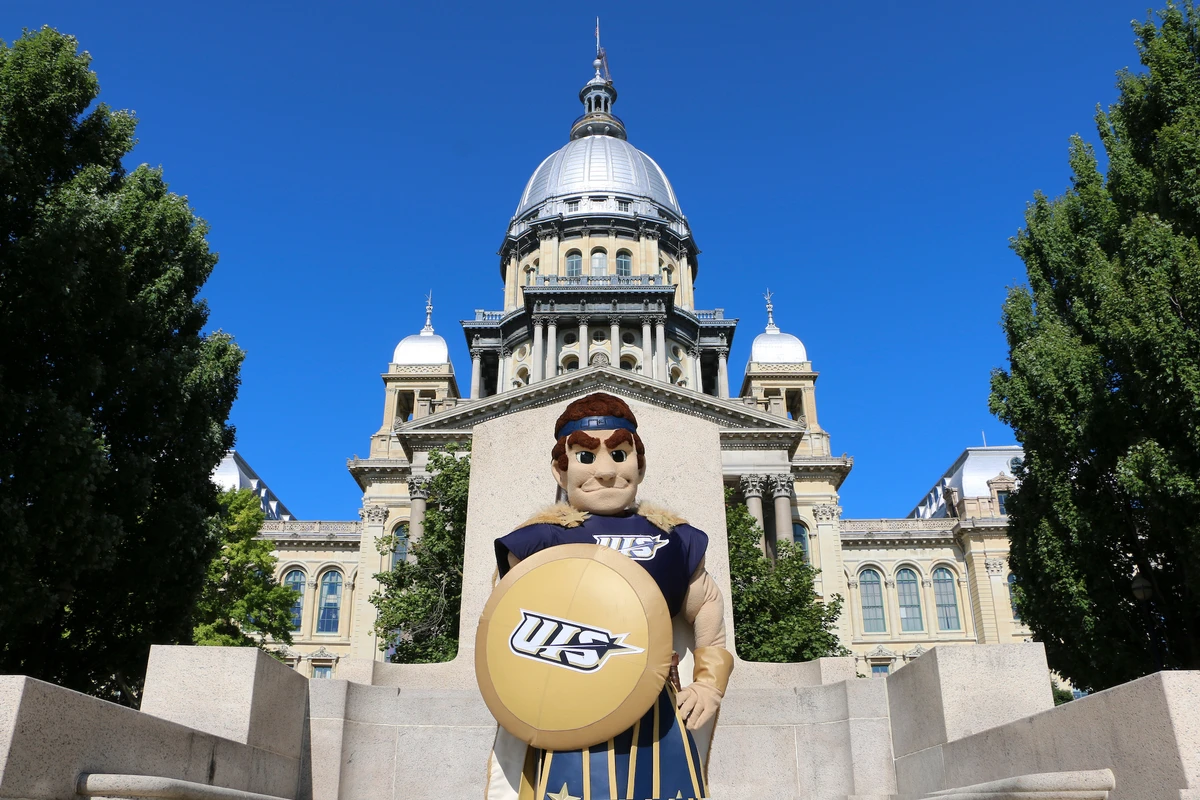

1970 – UIS was founded as Sangamon State University on September 28, 1970 (the first classes were held that day).
SSU was known as an upper-division college– a three-year institution, a capstone to the state’s community college system. SSU offered classes for juniors, seniors and graduate students. There were no freshmen or sophomores.
Karen Hasara was the second person in line to register for classes. She was later a state senator, served as the first female Mayor of Springfield, and became the first UIS alumna on the University of Illinois Board of Trustees. In 2019, she was presented with an honorary doctorate of humane letters during the UIS Commencement in recognition of her inspirational leadership, public service, and contributions to her community.
SSU’s curriculum was built around four University Programs:
The first president of SSU, was Dr. Robert C. Spencer. The Spencer’s lived in what is now the Cox Children’s Center.
1971 – In December, the first students graduated from SSU, although the first ceremony wasn’t until 1972.
1971 – During the spring semester, Professor Gus Stevens was criticized by a state senator for wearing a hat “in the presence of ladies.” Stevens responded by organizing the first “Floppy Hat Day” inviting students, faculty, and staff to join him in wearing floppy hats.
1971 – Baseball was established as the first SSU sports team.
1972 – SSU had classes downtown in the Leland Building.
1973 – Author Alex Haley appeared on campus as part of Black Awareness Week sponsored by SSU Black Student Union.
1975 – Singer Bobby McFerrin was a Peer Group Counselor.
1976 – Brookens Library was the first permanent building on campus – dedicated in May. This moved the library from building F, which is now the Student Affairs Building and home to the UIC College of Nursing at Springfield.
1978 – Dr. Alex B. Lacy Jr. became SSU’s second president in September. His vision for SSU included seeing the campus be at center stage for the study of government, politics, and public policy.
1978 – The University Observatory was dedicated on the roof of Brookens Library. The first “Star Party” was held.
1980 – The first on-campus student housing opened in August. The Public Affairs Center, the second permanent campus building opened in September.
1981 – Sangamon Auditorium held its first performance – Hal Holbrook in “Mark Twain Tonight!”
1984 – Dr. Durward Long, became SSU’s third president in July.
1986 – The Soccer Team won the first of three NAIA National Championship.
1991 – Dr. Naomi B. Lynn became the fourth president of SSU and then subsequently the first UIS Chancellor in 1995.
1992 – The Health & Sciences Building opened.
1995 – Sangamon State University became part of the University of Illinois system. The last SSU commencement was held in May of 1995.
1996 – UIS held its first homecoming (SSU held sponsored homecoming events in 1977, 1990, and 1994).
1999 – The Capital Scholars Honors program was created.
2001 – Richard D. Ringeisen became the second UIS Chancellor in April.
2001 – UIS welcomed its first freshman class in August, with the advent of the Capital Scholars Honors Program. 116 students moved into the first residence hall— Lincoln Residence Hall.
2004 – University Hall opened. Construction of UHB resulted in a planned quadrangle of landscaping bordered on the east of the new building.
2005 – The UIS Colonnade was completed and designated as the symbolic center of campus and the head of the new Quad.
2006 – UIS became a four-year university with the arrival of freshmen admitted to the general education curriculum.
2007 – The Recreation and Athletics Center (TRAC) was dedicated.
2007 – UIS alumna Dana Perino became White House Press Secretary to President Georgy W. Bush. Perino graduated in 1995 with an MA in Public Affairs Reporting.
2008 – Founders Residence Hall opened to house 132 freshmen. The partially completed building was named in honor of all those men and women who are recognized as SSU founders. Fun Fact: Founders Residence Hall has a green roof – covered in 26,000 feet of soil and sedum that acts as insulation for the building, reducing heating and cooling costs.
2010 – UIS Athletics became a member of NCAA Division II. UIS participates in the Great Lakes Valley Conference (GLVC).
2010 – 63 foreign flags were placed in the Public Affairs Center representing the countries from which international students had to travel to attend UIS over the past 40 years.
2010 – UIS/SSU celebrated its 40th Anniversary.
2011 – Dr. Susan J. Koch became third Chancellor of UIS.
2018 – The Student Union opened in January.
2022 – Dr. Janet L. Gooch became fourth Chancellor of UIS.
2023 – The Orion Lab opened in January.
2025 – Construction started on Library Commons in August. UIS Innovation Center relocated to the third floor of the Horace Mann building in September to expand its presence to downtown Springfield. UIS Athletics added women’s flag football as 18th varsity sport in December.
2026 – UIS opens the Sean and Taryn Grant/Landmark Auto Trading Lab in February. The lab features 12 Bloomberg Terminals that support hands-on learning for UIS students pursuing careers in finance, data analytics and related fields.
Mascot: Orion. Fun Fact: In Greek mythology, Orion the Hunter, was placed in the heavens by Zeus, in what is now the Orion Constellation.
Nickname: Prairie Stars
UIS’ official colors are UIS Blue and White. UIS Gold is a secondary color and used in Athletics.
Mission: The University of Illinois Springfield provides a uniquely student-centered educational experience both in and out of the classroom through active learning, meaningful research and impactful civic engagement that prepares graduates to contribute fully to society.
Vision: The University of Illinois Springfield will be a pathway to opportunity, a catalyst for change, and a space of possibility where learners become ethical and passionate scholars, leaders, and citizens capable of transforming their local and global communities.
Values:
Most of the streets at UIS are named after writers who were born, or lived in Illinois during their lifetime.
Nelson Algren (1909-1981) Lane – Best known for his novel turned movie Man with the Golden Arm. Algren grew up in the North and South side of Chicago and attended U of I (Urbana-Champaign) where he wrote for the campus newspaper.
Gwendolyn Brooks (1917-2000) Lane – Named after the Pulitzer-Prize winning poet, teacher and Poet Laureate of Illinois. Gwendolyn Brooks lived in Chicago attending 4 different racially diverse schools which gave her insights into the racial dynamics of the city that influenced her writing. She was 13 when her first poem was published.
Theodore Dreiser (1871-1945) Lane – Known mostly as a novelist and journalist, Dreiser wrote poetry and short stories. He worked as a reporter for the Chicago Glove in the late 1800s. His work was often controversial because he challenged moral codes with his writings on sex, prostitution, promiscuity, lynching, murder, and characters that triumphed even though they were involved in morally compromising situations.
Eliza Farnham (1815-1864) Drive – Novelist, feminist, and abolitionist, Farnham lived in Illinois for six years. She wrote about her experiences in Pekin in Life in the Prairie Land. She was an advocate for women in prison and in her later life helped destitute women to emigrate to the American west, helping them find new homes.
Edna Ferber (1885-1968) Lane – Fans of movies from the 30s, 40s, and 50s will know Ferber’s work that became blockbuster movies: Show Boat, Cimarron,
and Giant. The Pulitzer-Prize winning Ferber was a novelist, short story writer, and playwright who lived for a short period of time in Chicago, Illinois.
Ernest Hemingway (1899-1961) Drive – The Nobel Prize winner and author of some of America’s great classics was born and raised in Oak Park, Illinois and later lived and worked in Chicago.
Vachel Lindsay (1879-1931) Drive – A native son of Springfield, Illinois, Lindsay became famous as “the Prairie Troubadour.” A poet and performance artist, he published his poetry in pamphlets, which he read in a singing chant, and sold to people as he walked from town to town, through much of the eastern and midwestern United States. His childhood home at 603 South Fifth Street is maintained by the Illinois Historic Preservation Agency and is open to the public.
Edgar Lee Masters (1868-1950) Drive – Lee was a poet, biographer and attorney (who shared a practice with Clarence Darrow). Lee grew up in Lewistown, IL and was influenced by the Spoon River and Oak Hill Cemetery. He wrote Lincoln: the Man, a biography of Abraham Lincoln in 1931.
William Maxwell (1908-2000) Lane – American editor and author who wrote short stories and novels about small-town life in the American Midwest in the early 20th century. Maxwell taught English at the University of Illinois before joining the staff of The New Yorker.
Carl Sandburg (1878-1967) Lane – Sandburg was a three time Pulitzer Prize winning writer and poet. He was born and raised in Galesburg, IL and later lived in Chicago, Evanston, and Elmhurst, IL. His second volume of Abraham Lincoln: The Prairie Years was recognized with his first Pulitzer Prize for History in 1940.
Richard Wright (1908-1960) Drive – Wright and his family moved to Chicago as a young man to escape the Jim Crow south. His childhood in Mississippi and life in Chicago heavily influenced his award-winning writing about the lives of African American citizens and racism in America.
Need help? Feel free to contact us by phone or email using the information below.
Phone: 217-206-8181
Email: UISOrientation@uis.edu